Veezu took driver management in-house and saved £200,000 a year
£200,000+Saved each year
20,000+Active drivers supported
3 monthsComplete migration after launch
 Laravel
 Vue
Vue React Native
 MySQL
MySQL'%20d='M85.343.003h75.753L82.457%20233a12.08%2012.08%200%200%201-11.442%208.216H12.06A12.06%2012.06%200%200%201%20.633%20225.303L73.898%208.219A12.08%2012.08%200%200%201%2085.343%200z'/%3e%3cpath%20fill='%230078d4'%20d='M195.423%20156.282H75.297a5.56%205.56%200%200%200-3.796%209.627l77.19%2072.047a12.14%2012.14%200%200%200%208.28%203.26h68.02z'/%3e%3cpath%20fill='url(%23SVGzpurqcJr)'%20d='M85.343.003a11.98%2011.98%200%200%200-11.471%208.376L.723%20225.105a12.045%2012.045%200%200%200%2011.37%2016.112h60.475a12.93%2012.93%200%200%200%209.921-8.437l14.588-42.991l52.105%2048.6a12.33%2012.33%200%200%200%207.757%202.828h67.766l-29.721-84.935l-86.643.02L161.37.003z'/%3e%3cpath%20fill='url(%23SVGZ5kCkZNr)'%20d='M182.098%208.207A12.06%2012.06%200%200%200%20170.67.003H86.245c5.175%200%209.773%203.301%2011.428%208.204L170.94%20225.3a12.062%2012.062%200%200%201-11.428%2015.92h84.429a12.062%2012.062%200%200%200%2011.425-15.92z'/%3e%3c/svg%3e) Azure
Azure'%3e%3cstop%20offset='0.1'%20stop-color='%23ff45a6'/%3e%3cstop%20offset='0.8'%20stop-color='%2346bfe6'/%3e%3c/linearGradient%3e%3cpath%20fill='url(%23a)'%20d='M227.1,57.9C232.7,26,211.4,0,179.6,0H35.8L25.6,57.9h143.9l-3.4,19.3H22.2L0,204h57.6l12.1-69H156%20c31.8,0,62.1-26,67.7-57.9L227.1,57.9z'/%3e%3cscript%20xmlns=''/%3e%3c/svg%3e) Pest
Pest iCabbi
 Zendesk
 REST API
Agency dependency was slowing acquisition-led growth
Veezu was growing quickly through UK-wide acquisitions, but its driver management system was still dependent on an external agency. The business needed control over software that sat right in the middle of driver onboarding, compliance, invoicing, and support.
That created three problems at once. Ongoing costs were high, feature delivery was slow, and the business had limited technical control over a system that touched compliance, onboarding, invoicing, and driver communication.
The process around the system was not scaling either. Teams relied on spreadsheets and manual checks to manage driver records, legal documents, agreements, payment visibility, and support conversations. That might work for a smaller fleet. It does not work cleanly when the business is acquiring operators and needs consistent processes across thousands of drivers.
RoleBuilding the platform and the engineering function
I was brought in as Lead Software Engineer to establish an internal engineering function and deliver a new in-house platform.
At the start, I worked as the sole engineer alongside a key Director. I owned the architecture, delivery plan, and early engineering standards, then helped grow the team with permanent and contract support once the platform had clear foundations.
Veezu needed more than Laravel delivery. They needed someone who could build the product, reduce agency dependency, set up safer engineering habits, and make decisions that would stand up to ISO27001-aligned processes.
SolutionAn in-house Laravel platform for driver operations
I built a custom Laravel and PHP platform backed by MySQL.
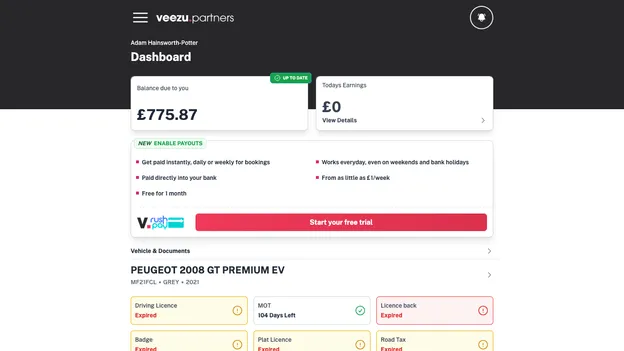
The system covered backend business logic, an internal admin portal for staff, a driver-facing web application, and a mobile application. It automated onboarding, legal document upload and verification, agreement acceptance with audit history, driver earnings visibility, and invoicing.
I also integrated iCabbi so dispatch and driver data stayed synchronised, and Zendesk so support messaging could happen inside the driver experience rather than being handled as a disconnected channel.
The critical workflows were protected with unit and feature tests using Pest. That mattered because onboarding and invoicing are exactly the parts of the system where quiet mistakes become expensive.
 Challenges
Replacing a live dependency without copying the mess
The main challenge was replacing a live operational dependency without creating a bigger one.
The platform had to absorb real business rules from multiple acquired operators, while still giving Veezu a cleaner shared process. A direct copy of every local workaround would have preserved the mess. A neat greenfield model would have ignored how the business actually worked. The right answer sat between those two.
Migration was another risk. Driver records, documents, agreements, and payment data had to move into the new platform without losing trust from staff or drivers. That meant alpha and beta phases, careful iteration, and enough test coverage to keep critical workflows stable while the product changed.
The engineering process mattered too. Bringing the work in-house only saved money if the new team could safely extend the system afterwards.
OutcomeMore control, faster growth, and £200,000 saved each year
The platform supported more than 20,000 active drivers and removed Veezu’s dependency on the external agency, saving more than £200,000 per year.
It also gave the business more control over a platform it depended on every day. Continued acquisition-led growth no longer needed the same proportional increase in admin work, and the full migration was completed within three months of launch.
Our Laravel platform now handles over 20,000 active drivers and saves us over £200,000 a year on external agency costs. It gives us more control over a system the business depends on.
