City Taxis automated NHS transport handling 115,000+ bookings in year one
115,000+NHS bookings processed in year one
1 FTESaved through automation
£2.5m+Annual contract supported
 Laravel
 Vue
Vue MySQL
MySQL AWS
AWS iCabbi
 Webhooks
 REST API
 XML
XML
Manual NHS bookings were adding cost and risk
City Taxis handled high-volume NHS patient transport alongside private hire work, but the workflow still depended on people re-keying bookings by hand.
Bookings came in through spreadsheets, email, or a portal, then had to be manually entered into iCabbi. Staff also had to return KPI timestamps to the NHS system, with strict reporting requirements around pickup, arrival, and completion events.
That process created delays, avoidable errors, and a lot of admin. The work was important, time-sensitive, and easy to get wrong in small but costly ways. It also made pricing harder when contracts went out to tender because operational cost was baked into every booking.
This was not just a convenience problem. Patient transport depends on trust, timing, and reporting. A missing timestamp or incorrectly keyed booking could create a complaint, a contract issue, or extra work for a team that was already busy.
RoleOwning the workflow from booking to KPI reporting
I was the sole in-house engineer and owned the end-to-end delivery.
My job was to automate booking creation, monitoring, and KPI reporting between iCabbi and the NHS provider Cleric. I had to understand the operational workflow, the data constraints, and the reporting requirements, then turn that into a reliable Laravel system the call centre could actually use.
This suited me because the problem crossed several boundaries at once: backend automation, third-party integration, admin tooling, data validation, reporting, and security. It needed careful engineering, but it also needed judgement about how people would handle exceptions during a live shift.
SolutionA Laravel bridge between Cleric and iCabbi
I built the core service in Laravel and PHP, using webhooks and background jobs to keep bookings synchronised and resilient.
The heart of the system was a translation layer between Cleric’s XML schema and iCabbi’s REST and JSON API. It validated incoming data, mapped fields into the right dispatch model, and handled edge cases where the two systems did not line up neatly.
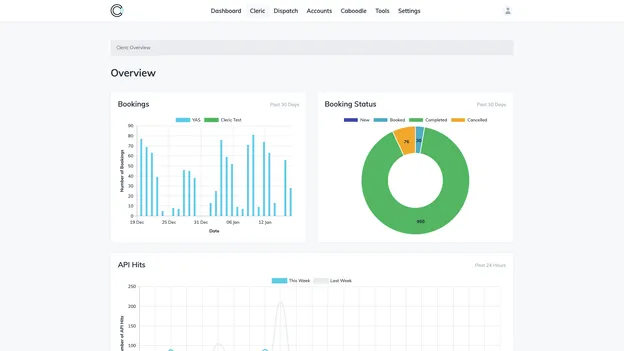
I also built an internal Vue.js admin interface with dashboards and a wallboard view for the call centre. That gave staff visibility over booking status, exceptions, and timestamps without asking them to dig through raw data.
To meet NHS Trust Information Governance approval, I implemented encryption, audit logging, access control, data retention policies, and AWS hosting.
 Challenges
Turning healthcare transport data into trusted automation
The difficult part was not sending a booking from one system to another. It was making the whole workflow reliable when real-world data was messy.
Cleric and iCabbi used different models, formats, and assumptions. The translation layer had to handle that without silently creating bad bookings. Exceptions needed to be visible enough for staff to fix, but not so noisy that the team ignored them.
KPI reporting created another trap. A timestamp can look valid while still being suspicious. I added anomaly detection to flag unusual timestamps before submission, which reduced the chance of incorrect performance data being sent back to the NHS system.
The system also needed to earn trust from operational staff. Automation only helps if people believe it, so the admin tools had to show enough detail to explain what happened when something looked wrong.
Outcome115,000+ bookings processed with no missing timestamp complaints
In the first year, the system processed more than 115,000 NHS bookings, eliminated booking and timestamp errors, saved 1 FTE, and supported a contract worth more than £2.5m per year.
It also gave City Taxis immediate KPI reporting and removed missing timestamp complaints from a workflow that had previously depended on manual admin.
We've automated over 115,000 NHS bookings in the first year. The system is secure, reliable, and now sits at the centre of how we manage that work.
